SAMHSA-listed Free insurance check HIPAA confidential No commitment
Updated October 21, 2026 · programs checked against SAMHSA on October 20, 2026
15 drug and alcohol treatment programs have a Bridgeport street address in SAMHSA's federal locator, FindTreatment.gov. We checked every one on October 20, 2026: 6 run methadone programs, only 2 offer detox, 4 offer 24-hour residential care, and 13 accept HUSKY, Connecticut's Medicaid.
Detox is the bottleneck. First Step on Grant Street and New Era on Main Street are the only Bridgeport sites that list it. Detox options
Methadone is not. Six sites run opioid treatment programs, and 11 of 15 list buprenorphine. Methadone clinics
Public coverage is wide. 13 take Medicaid, 10 take Medicare and 9 charge on a sliding fee. Paying for rehab
How we counted: SAMHSA's export within 10 miles of downtown gave 54 rows for 32 sites; 15 sit inside city limits. A program's services are what it reported to SAMHSA. The first directory cards below are the centers from our verified catalog in and around Bridgeport; the SAMHSA locator cards after them come from our national database, which groups records by organization name, so some of them describe the same organizations' sites in other towns and states. The address-checked list is in Bridgeport treatment programs checked against SAMHSA.
Verified centers in and around Bridgeport
7 centers from our verified catalog are in Bridgeport or within 25 miles of it in Connecticut: 2 in Bridgeport itself and 5 in nearby towns, nearest first.
How this count is built: these are centers from our catalog of 1,194 verified centers nationwide, the same list as the Connecticut state guide (16 centers) and our treatment search. A center counts here if it is in Bridgeport or its town is within 25 miles of Bridgeport in Connecticut; distances are measured between town centers from the U.S. Census Bureau's 2023 Gazetteer.
SAMHSA locator listings for Bridgeport
SAMHSA lists 48 programs within 25 miles of Bridgeport in Connecticut (FindTreatment.gov records, imported October 2025); 10 of them have a street address in Bridgeport and are listed below. These are federal locator records, not our verified catalog, so they are counted separately from the centers above.
How this list is built: every center above has a street address in Bridgeport, Connecticut in its SAMHSA treatment-locator record. Another 40 records in our database carry Bridgeport as the city but give an address somewhere else, so they are not counted or shown on this page: 12 are in other Connecticut cities (New Haven 2, Waterbury 2, Danbury 2, Stamford 1, Greenwich 1, Torrington 1, Westport 1, Kent 1 and others); 3 are elsewhere in Connecticut; 25 are outside Connecticut, including other states and countries. Statewide listings are in the Connecticut state guide.
The 25-mile SAMHSA figure above counts only locator records whose street address confirms their own town, with distances measured between town centers; it is a count of federal records, separate from our verified catalog.
Filed under Bridgeport, located in another Connecticut city:
Chemical Abuse Services Agency CASA/MAAS Methadone Supported Servs — New Haven, CT
Liberation Programs Greenwich Youth & Family Resources — Greenwich, CT
Liberation Programs Main Street Clinic — Stamford, CT
Liberation Programs Westport Youth & Family Resources — Westport, CT
Lifebridge Community Services- Fairfield — Fairfield, CT
MCCA McDonough House/ ASAM 3 7 R Intensive — Danbury, CT
MCCA Trinity Glen Womens Program — Kent, CT
McCall Behavioral Health Network Dempsey Center — Waterbury, CT
McCall Behavioral Health Network McCall House — Torrington, CT
McCall Behavioral Health Network Renato Outpatient Clinic — Waterbury, CT
McCall Behavioral Health Network Travisano Outpatient Clinic — Danbury, CT
New Era Rehabilitation Center NERC — New Haven, CT
BRIDGEPORT treatment profile
Addiction treatment options in Bridgeport
Levels of care available
Level of care
SAMHSA listings in Bridgeport
Outpatient
9 of 10
Co-Occurring Mental Health
8 of 10
Detox
1 of 10
Residential Rehab
1 of 10
Insurance accepted by Bridgeport centers
Federal records do not say which insurance companies a program has contracts with. They list payment categories, and that is what we count here for the 15 address-checked Bridgeport programs. Whether your own plan is in network can only be confirmed by the plan or the program.
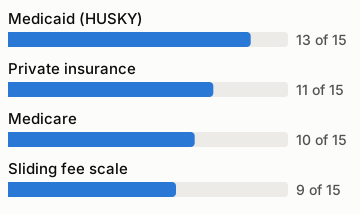
Medicaid (HUSKY)13 of 15Private insurance11 of 15Medicare10 of 15Sliding fee scale9 of 15
To check a specific plan, call the member number on the back of your card and ask for in-network substance use providers in ZIP codes 06604 to 06610. HUSKY members can call the Connecticut Behavioral Health Partnership at 877-552-8247, run by Carelon for the state (ctbhp.com). Our helpline at (866) 227-8929 can also check benefits with you on the line. More on how coverage works: insurance coverage for rehab.
Counts reflect services reported to SAMHSA by the 10 SAMHSA listings with a Bridgeport address shown above. Always verify current details directly with each facility.
Address-checked list · October 2026
Bridgeport treatment programs checked against SAMHSA
Fifteen drug and alcohol programs have a street address inside Bridgeport, and 11 more are within 10 miles. The 11 are in Stratford, Fairfield, Southport, Shelton, Milford and Westport. Every card below shows what the program reported to SAMHSA's FindTreatment.gov, whether it holds a Connecticut Department of Public Health substance use license, and how far it is from City Hall. Thirteen of the 15 match a state license at the same address: 11 active and 2 in renewal. The two that do not are both run by the state itself through DMHAS.
What the list leaves out matters as much. SAMHSA does not publish waiting times, open beds or prices, and neither do we. Opening hours change and we did not phone every program, so treat each card as a starting point and confirm with the program. If you would rather talk it through first, our helpline at (866) 227-8929 is free and open 24 hours.
What do you need?
Tick what matters to you. A program stays on the list only if it reported every item you tick. Nothing is sent anywhere; the filter runs in your browser.
26 of 26 programs match.
No program reported that exact combination. Untick one item, or call (866) 227-8929 and we will look with you.
Map: 15 programs in Bridgeport (gold markers) and 11 within 10 miles (white markers), placed by SAMHSA coordinates. Every address is also written out in the cards, so nothing on the map is missing from the text.
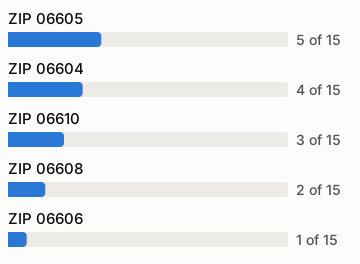
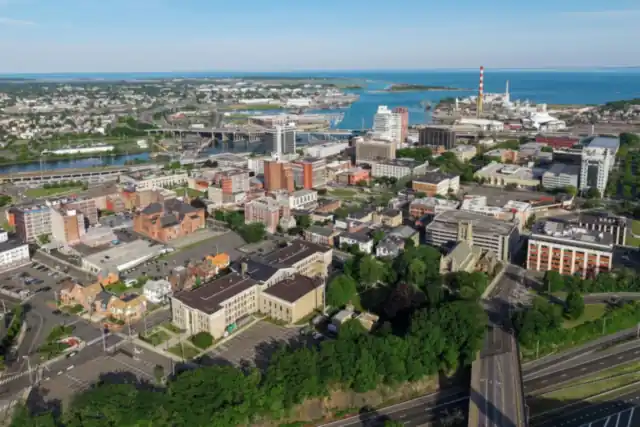
The 15 Bridgeport programs by ZIP code, from their SAMHSA addresses (Oct 20, 2026). The cards below group them by neighborhood.Downtown Bridgeport from the air, June 2026. Photo: Quintin Soloviev, CC BY 4.0, via Wikimedia Commons.
Downtown and the East Side (06604, 06608)
Six programs sit within about a mile of City Hall, most of them along Fairfield Avenue, John Street and the East Side near Kossuth and Arctic Streets.
Southwest Connecticut Mental Health System Bridgeport
Outpatient care with buprenorphine or naltrexone, listed under the state-run Southwest Connecticut Mental Health System. The federal record lists Medicaid, Medicare and a sliding fee, but not private insurance.
One of four Bridgeport programs that accept adolescents. No addiction medication is listed for this site, so ask about it at intake if a teen may need buprenorphine.
Downtown intensive outpatient program at 140 John Street, a short walk from City Hall. Its federal record lists no Spanish-language service, so ask before you go if you need one.
CASA Intensive Outpatient (Kossuth Street) Bridgeport
CASA's East Side outpatient and IOP site. The state license at this address is held under the name Project Courage, which is the name you will see in the eLicense register.
Appears on SAMHSA's opioid treatment program list, which carries no detail on payment, language or groups served. Its state license is active through June 2028; call to confirm what it offers.
CASA Hostos Outpatient Treatment (Arctic Street) Bridgeport
The only Bridgeport address in the locator that combines 24-hour residential care, a day program, IOP and methadone. Licensed by the state as CASA Eugenio Maria de Hostos.
Outpatient and IOP with buprenorphine, Spanish, ASL and a sliding fee. The same health center holds two more DPH substance-use licenses in the city, at 968 Fairfield Ave and 46 Albion St.
Methadone and buprenorphine clinic on Commerce Drive, 1.5 miles from City Hall. One of two Bridgeport methadone programs that list adolescents. The DMHAS clinic list shows 1438 Park Ave, another RNP site; SAMHSA and the state license use Commerce Drive.
The East End has First Step, the medically monitored detox unit, plus the state mental health center and the Liberation methadone clinic.
Greater Bridgeport Community Mental Health Center Bridgeport
State-run center for adults. DMHAS describes a 20-bed co-occurring inpatient unit (2019 page), but beds are assigned through a statewide utilization process, not by walking in. New patients start at the Diagnostic and Evaluation Center.
Medically monitored residential detox for adults 18 and over withdrawing from alcohol, opiates or benzodiazepines, per its operator. SAMHSA lists it as First Steps Detoxification Program.
Lists 20 of the 25 features we tracked, more than any other Bridgeport site, including teens, Spanish and ASL. Also runs a licensed Wellness Van and hands out naloxone and fentanyl test strips.
One program serves the North End: New Era on Main Street, 3.2 miles from City Hall.
New Era Rehabilitation Center Bridgeport
North End methadone program that also lists detox and a day program. It is the farthest Bridgeport site from City Hall (3.2 miles) and the only one in ZIP 06606.
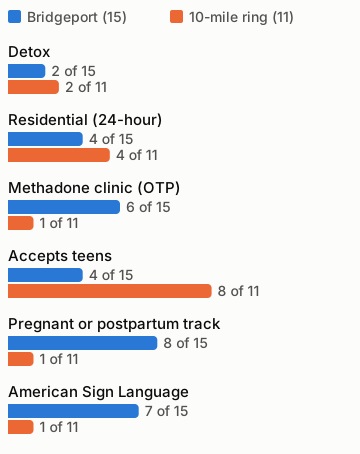
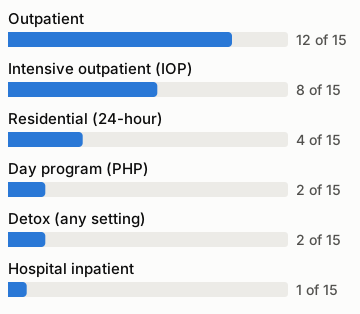
Bridgeport is strong on outpatient care and medication, and thin on beds. Twelve of the 15 programs offer standard outpatient treatment and 11 use buprenorphine, but only 4 have 24-hour residential care and 2 list detox. The table counts each service once per program, using what the program reported to SAMHSA. The right-hand column shows the 11 programs within 10 miles, which is where to look for what the city lacks.
What the 15 Bridgeport programs and the 11 programs within 10 miles report to SAMHSA. Checked Oct 20, 2026; one row per service, a program can count in many rows.
Service or feature
Bridgeport (15)
Within 10 miles (11)
Detox (any setting)
2 of 15
2 of 11
Residential, 24-hour
4 of 15
4 of 11
Hospital inpatient
1 of 15
2 of 11
Day program (partial hospitalization)
2 of 15
1 of 11
Intensive outpatient (IOP)
8 of 15
4 of 11
Standard outpatient
12 of 15
7 of 11
Methadone program (OTP)
6 of 15
1 of 11
Buprenorphine
11 of 15
5 of 11
Naltrexone
10 of 15
5 of 11
Medicaid (HUSKY)
13 of 15
7 of 11
Medicare
10 of 15
5 of 11
Private insurance
11 of 15
11 of 11
Sliding fee scale
9 of 15
2 of 11
Services in Spanish
10 of 15
4 of 11
American Sign Language
7 of 15
1 of 11
Accepts adolescents
4 of 15
8 of 11
Pregnant or postpartum program
8 of 15
1 of 11
Veterans program
7 of 15
4 of 11
Co-occurring mental health program
12 of 15
7 of 11
Naloxone and overdose education
12 of 15
7 of 11
Housing services
10 of 15
6 of 11
Telehealth
12 of 15
7 of 11
CARF accredited
7 of 15
1 of 11
Joint Commission accredited
4 of 15
3 of 11
Non-profit operator
10 of 15
4 of 11
Where the gaps are
Three gaps stand out. Detox: two Bridgeport sites, and two more in the ring (Shores Mental Health in Westport, a hospital unit, and Elevate in Westport). Residential: four in the city, two of them run by Recovery Network of Programs and one by the state. Teens: only 4 of 15 Bridgeport programs accept adolescents, while 8 of the 11 ring programs do, so a family with a teenager may need to look in Stratford, Fairfield, Southport, Milford or Westport. Two of those eight are Center for Discovery residential sites that describe themselves as eating-disorder programs, so ask whether they treat substance use as the main problem. See teen rehab for what adolescent programs look like.
Bridgeport (blue, 15 programs) against the 10-mile ring (orange, 11 programs). Bar length is the share of programs; labels give the count. SAMHSA data, our count, Oct 20, 2026.
Pregnancy is the reverse. Eight Bridgeport programs list a pregnant or postpartum track, against one in the ring, and four of the six Bridgeport methadone programs are among them. Our guide to help for pregnant women covers what to ask.
Help in Spanish and for Deaf clients
About 45 percent of Bridgeport residents are Hispanic or Latino, and roughly 36 percent of residents age 5 and older speak Spanish at home, according to the Census Bureau's 2020 to 2024 American Community Survey. Ten of the 15 programs list services in Spanish. Seven list American Sign Language, which is rare: in the 10-mile ring, only one does. Connecticut AA's meeting list shows 8 Spanish-language meetings a week in Bridgeport out of 39.
Spanish is not listed at MCCA on John Street, CASA's Kossuth Street site or Recovery Counseling Services on Fairfield Avenue, and the short federal records for North Star and First Step do not mention language at all. If you need Spanish, filter the list above or ask the program when you call.
Intensive outpatient (IOP) and virtual or telehealth options
An intensive outpatient program means structured group and individual therapy on several days a week while you keep living at home. Eight Bridgeport programs run IOP, from MCCA downtown to New Era on Main Street. Twelve of 15 list telehealth, so some sessions, check-ins or medication visits can happen by video. Ask each program which visits can be virtual. More detail: how IOP works and telehealth recovery.
Withdrawal and beds
Detox and inpatient care in Bridgeport
Two Bridgeport programs list detox: First Step at 425 Grant Street and New Era Rehabilitation Center at 4675 Main Street. Four offer 24-hour residential treatment: CASA's Hostos program on Arctic Street, Horizons on Fairfield Avenue, First Step, and the state-run center on Central Avenue. Within 10 miles, Shores Mental Health in Westport and Elevate Health and Wellness in Westport also list detox. If you need a detox bed tonight, the DMHAS Access Line at 1-800-563-4086 checks what is open.
Levels of care at the 15 Bridgeport programs, as each reported to SAMHSA. Our count, Oct 20, 2026. A program can offer several levels.
Medically monitored detox: First Step (425 Grant St)
First Step is run by Recovery Network of Programs, which describes it as "a medically monitored residential detoxification unit helping those 18 and over detoxing from alcohol, opiates, and/or benzodiazepines." Medical staff assess each person and give medication for a safe withdrawal, counselors use motivational interviewing and cognitive-behavioral therapy, and aftercare planning starts on admission, with referrals to residential, intensive outpatient, medication-assisted and mental health programs. It also offers intensive services for people living with HIV and psychiatric conditions. First Step holds an active state license through September 2028. The operator does not publish bed numbers, length of stay or fees, so ask when you call. What to expect in the first days: what happens during detox.
New Era, on Main Street in the North End, lists detox alongside its methadone program, a day program and IOP, and accepts Medicaid, Medicare and private insurance. Its federal record does not say which substances its detox covers, so confirm whether it handles alcohol withdrawal before you go.
Hospital-based care: Bridgeport Hospital and St. Vincent's
Neither Bridgeport hospital appears in SAMHSA's locator or in the DMHAS withdrawal management listing as a Bridgeport detox program; in that DMHAS listing, the only Bridgeport detox is First Step. St. Vincent's Medical Center (Hartford HealthCare) runs its behavioral health services at 2400 Main Street: an adult inpatient unit for mental illness, including people who also have a substance use disorder (dual diagnosis), plus an outpatient clinic for teens and adults, and 24-hour emergency psychiatry, per St. Vincent's. Its pages do not describe a stand-alone detox unit. St. Vincent's inpatient unit for children, teens and adults, The Shores, is in Westport at 47 Long Lots Road, and that site does list detox in SAMHSA's locator.
We could not open Bridgeport Hospital's own pages to confirm what it offers for addiction, so we do not list it as a detox. In a medical emergency, including severe alcohol withdrawal, call 911 or go to the nearest emergency room; for a planned detox, start with First Step, New Era or the Access Line.
How long detox and residential stays last
Detox usually takes days, and treatment after it takes months. SAMHSA's detox protocol (TIP 45, 2006) says alcohol withdrawal usually begins 6 to 24 hours after the last drink, with most withdrawal seizures in the first 48 hours, and the course is "extremely variable"; its sample medication schedule tapers by day 5. Heroin withdrawal usually begins 8 to 12 hours after the last dose and passes in 3 to 5 days, while methadone withdrawal starts later and can last 3 weeks or more. Fentanyl is not covered separately in that 2006 guide, so ask the detox team what to expect.
NIDA's research guide is blunt about what comes next: "Medically assisted detoxification is only the first stage of addiction treatment." Most people need at least 3 months in treatment to significantly reduce or stop their drug use, residential or outpatient treatment shorter than 90 days is generally "of limited effectiveness", and 12 months is the minimum for methadone maintenance (NIDA, revised 2012). In Connecticut, intensive residential treatment after detox is described by DMHAS as a 15- to 30-day level of care. There is no fixed length that fits everyone; see how long rehab takes.
Medication for opioid use disorder
Methadone and buprenorphine clinics in Bridgeport
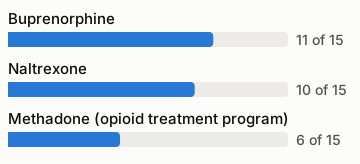
Six Bridgeport sites are on SAMHSA's list of certified opioid treatment programs (OTPs), the clinics that dispense methadone for opioid use disorder. Buprenorphine is more widely available: 11 of the 15 Bridgeport programs list it, and naltrexone is listed at 10. The nearest methadone program outside the city is Center for Human Services on Research Drive in Stratford.
Bridgeport opioid treatment programs (SAMHSA OTP list, checked Oct 20, 2026). Hours are not listed because they change; call before your first visit.
Detox, day program, IOP, buprenorphine, naltrexone
Medicaid, Medicare, private
Medications used by the 15 Bridgeport programs (SAMHSA, our count, Oct 20, 2026). Only certified opioid treatment programs can dispense methadone for addiction.
First Step is on the opioid treatment program list, but its operator describes it as a detox unit, so if you want ongoing methadone maintenance, ask before you go or start with one of the other five. North Star's federal record carries no detail beyond its address, though its state license is active. For buprenorphine without daily clinic visits, ask any of the 11 programs that list it. More on how medication treatment works: medication-assisted treatment guide and opioid treatment.
Who can start methadone and how intake works
Federal rules no longer require a year of opioid addiction before you can start methadone. Since the SAMHSA rule that took effect on April 2, 2024, an opioid treatment program can admit anyone with moderate or severe opioid use disorder, including people in remission or at high risk of relapse or overdose (42 CFR § 8.12). There is no federal cap on how many times you can restart. Patients under 18 need written consent from a parent, guardian or responsible adult unless state law lets minors consent on their own. Refusing tests for other illnesses does not by itself bar you from treatment.
Take-home doses are also more flexible than they were. Under the federal rule, a clinic may give doses for days it is closed from the first day, and at the doctor's discretion up to 7 take-home doses in the first two weeks, up to 14 from day 15 and up to 28 from day 31. Those are federal ceilings, not promises; each clinic's doctor decides. If no full program can take you within 14 days, a clinic can offer interim treatment for up to 180 days, with pregnant patients first in line.
Are methadone clinics free? Medicaid and sliding fees
Methadone is not free, but Medicare covers it without a copayment and four of the six Bridgeport programs take Medicaid. Medicare covers methadone, buprenorphine and naltrexone at an enrolled opioid treatment program with no copayment after the Part B deductible, and people with both Medicare and Medicaid pay nothing for services covered through the state Medicaid program, per Medicare.gov. HUSKY A, C and D cover methadone maintenance and Suboxone (buprenorphine) treatment with no referral needed and at no cost to the member, according to the HUSKY A, C and D member handbook (revised May 2026); members who also have Medicare may owe a pharmacy copay. Four of the six Bridgeport methadone programs list Medicaid, and three (CASA's Arctic Street site, Liberation and Kinsella) also list a sliding fee for people without coverage. Without any coverage, methadone costs far less than residential care: NIDA put it at about $4,700 per patient per year in 2012. When you look for methadone clinics near you that accept Medicaid, these four are the Bridgeport answer; Center for Human Services in Stratford also lists Medicaid.
Money
Paying for rehab in Bridgeport: HUSKY, Medicare and sliding fees
Medicaid is the one payment almost every Bridgeport program accepts: 13 of the 15 take HUSKY. HUSKY Health, Connecticut's Medicaid program, covers outpatient and intensive outpatient care, withdrawal management and, since June 1, 2022, residential treatment for members age 13 and older at certified programs, according to the Connecticut Department of Social Services. Of the same 15 programs, 11 take private insurance, 10 take Medicare and 9 offer a sliding fee based on income.
Payment categories the 15 Bridgeport programs reported to SAMHSA (our count, Oct 20, 2026). These are categories, not a list of insurers; ask the program about your plan.
Do you have to pay for detox or rehab?
It depends on coverage, not on whether the problem is drugs or alcohol. HUSKY pays only programs that are certified and enrolled with the state for the level of care you need, so the first question at intake is whether the program is a HUSKY provider for that service. With Medicare, treatment at an enrolled opioid treatment program has no copayment, though the Part B deductible applies, per Medicare.gov. Medicare Part A covers inpatient hospital stays; it does not describe coverage for non-hospital residential rehab. Private plans regulated by Connecticut must cover medically necessary inpatient detox under C.G.S. § 38a-492p, and limits such as prior authorization cannot be stricter than for physical health care (§ 38a-488c). Self-funded employer plans fall under federal law instead, so ask your HR or plan administrator which rules apply.
Not on HUSKY yet? You can apply or check eligibility through Access Health CT at 1-855-805-4325.
What rehab costs in Connecticut
No public source gives an honest "average price" for rehab in Connecticut, so we will not invent one. How expensive inpatient rehab is depends mostly on the level of care, the length of stay and the size of the program. The closest public numbers are what the state proposed to pay providers. In August 2022, DSS published proposed Medicaid daily rates for adult residential care: about $153 to $342 a day for low-intensity residential treatment (ASAM level 3.1, depending on program size), and $451 to $513 a day for medically monitored residential detox (level 3.7-WM), with room and board paid separately at about $43 to $46 a day. These are 2022 proposals, not 2026 prices, and they are what Medicaid pays a provider, not what a patient is billed.
Worked example, using those 2022 proposed rates
5-day detox at level 3.7-WM: 5 × $451 to $513 ≈ $2,260 to $2,570; a 7-day stay ≈ $3,160 to $3,590.
28 days of level 3.1 residential care: 28 × $153 to $342 ≈ $4,280 to $9,580, plus about $1,210 to $1,280 for room and board.
A 90-day alcohol or drug rehab stay at level 3.1 in a large program: 90 × $153 ≈ $13,760, plus about $3,900 for room and board.
Private programs set their own prices and can charge far more. Methadone is much cheaper per year: NIDA estimated about $4,700 per patient per year back in 2012, and that figure is old. Ask any program for a written estimate before admission. More on what drives the bill: the cost of rehab, explained.
If you have no insurance
Start with the programs that list a sliding fee: nine in Bridgeport, including the CASA sites, Liberation, Kinsella, MCCA and Southwest Community Health Center. The state-run Greater Bridgeport Community Mental Health Center at 1635 Central Avenue says it accepts Medicaid and Medicare, uses a sliding scale based on family size and income, and does not turn people away for inability to pay. The DMHAS Access Line (below) screens any Connecticut resident who calls and refers them to treatment. We could not find a published DMHAS fee schedule, so ask each program what you would owe before you start. See also finding free rehab options and how people pay for rehab.
Getting in
How to get into treatment through Connecticut DMHAS
The main public route into a detox or residential bed from Bridgeport is the DMHAS Addiction Services Access Line, 1-800-563-4086, open 24 hours a day. A screener assesses you by phone, looks for an open detox or residential bed, refers you to outpatient or medication treatment, and when a bed is open sets up a three-way call with the program. Bridgeport belongs to DMHAS Region 1, the 14 towns of southwestern Connecticut.
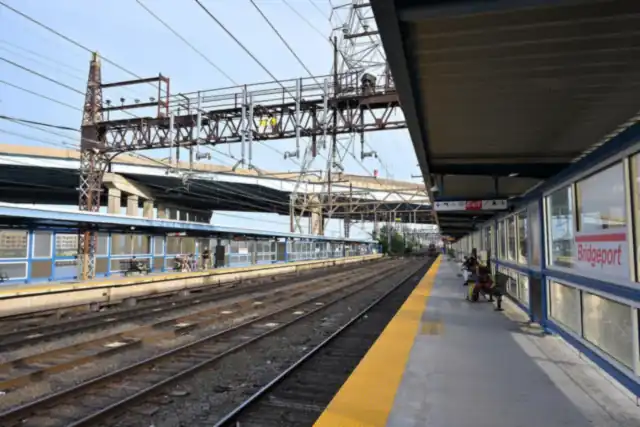
Bridgeport station, June 2026. The Access Line arranges a ride to a bed only as a last resort, so plan how you will get to intake. Photo: 4300streetcar, CC BY 4.0, via Wikimedia Commons.
The DMHAS Access Line (24/7) and transport to detox
The line is run for the state by Wheeler. Call 1-800-563-4086 yourself, or with the person you are worried about sitting next to you; the screening happens on that call. If a detox or residential bed is found and you have no other way to get there, DMHAS can arrange a ride there and back, but only as a last resort, and not for outpatient visits or medication appointments. A screener checks availability; the line does not promise a bed.
Before you call: have your HUSKY or insurance card, a list of medications, and the substances and amounts used in the last few days.
On the call: mention any past seizures, hallucinations or severe shaking when you stopped alcohol or benzodiazepines, so the screener can judge how much medical support you need. Why it matters: alcohol withdrawal dangers.
After the call: if a bed is not open today, ask to be referred to an outpatient program or a methadone or buprenorphine clinic that can start sooner. Six Bridgeport methadone programs are listed below.
Greater Bridgeport Community Mental Health Center (Region 1)
The state's own center for adults is the Greater Bridgeport Community Mental Health Center at 1635 Central Avenue, part of the Southwest Connecticut Mental Health System. New patients start at its Diagnostic and Evaluation Center, Monday to Friday, 8 a.m. to 4 p.m., 203-551-7423. For a mental health or substance use crisis in the Bridgeport area, DMHAS lists 1-800-586-9903. The center's inpatient beds are assigned through a statewide review, not by walking in, so the Access Line or an outpatient program is the practical first step.
Two other doors are worth knowing. Catalyst CT's The Hub, the regional behavioral health action organization at 2470 Fairfield Avenue (203-579-2727), gives out free naloxone kits and training and publishes a resource guide in English and Spanish. The city's Social Services Department (part of Health and Social Services) at 999 Broad Street (203-576-7416, Monday to Friday 9 a.m. to 5 p.m.) helps residents find services through a referral form but does not run treatment itself. For anything else, 211 Connecticut answers around the clock; from outside the state, dial 1-800-203-1234.
If someone refuses help
Connecticut law allows treatment without consent only in narrow cases. Under C.G.S. § 17a-684, a relative or other responsible person can file a written application, backed by a doctor who examined the person within the last two days, for an emergency admission of someone who is intoxicated and dangerous or needs detox to stay alive. That hold lasts up to 5 days. Under § 17a-685, a spouse or relative can petition the Probate Court; if the court finds clear and convincing evidence, it can order inpatient treatment for 30 to 180 days. The person has a right to a lawyer, free if they cannot pay, and the applicant must arrange the treatment place in advance and pays the costs unless unable to.
A court order is a last step, not a first one. A calm conversation, a planned intervention or a call to the Access Line together is where most families start. Our intervention guide for families walks through it, and CCAR's family support groups in Bridgeport are listed below. If anyone is in immediate danger, call 911; for a mental health crisis, call or text 988.
If you would rather talk to someone outside the state system first, the federal SAMHSA National Helpline at 1-800-662-4357 is free, confidential and open 24 hours a day in English and Spanish; it refers callers to local programs and does not provide treatment itself.
Our helpline routes calls to licensed treatment providers. The DMHAS Access Line above is the public route to state-funded beds.
Local data
Overdose deaths in Bridgeport, 2012 to 2024
This section has numbers about overdose deaths. If you are struggling right now, call or text 988, or call our helpline at (866) 227-8929. You can skip ahead to recovery support in Bridgeport.
Overdose deaths among Bridgeport residents fell from 89 in 2023 to 74 in 2024. The city's rate is still almost twice the state's: 49.8 deaths per 100,000 residents against 27.2 for Connecticut. We counted these from the state medical examiner's open data, because no official city-level summary is published. Bridgeport has about 4.1 percent of Connecticut's population and accounted for 7.5 percent of its accidental drug deaths in 2024.
Bridgeport resident overdose deaths by year (light bar) and those involving fentanyl (dark). Our count of OCME open data, Oct 20, 2026.
Accidental drug deaths of Bridgeport residents by year of death, with the drugs found. Our count from the Office of the Chief Medical Examiner open dataset (data.ct.gov, rybz-nyjw, 2012 to 2024), recounted Oct 20, 2026. Rates use the 2020 Census population (Bridgeport 148,654; Connecticut 3,605,944). One death can involve several drugs.
Year
Bridgeport residents
Per 100,000
Fentanyl
Cocaine
Xylazine
Heroin
All Connecticut
CT per 100,000
2012
13
8.7
0
5
0
6
355
9.8
2013
23
15.5
9
16
0
6
490
13.6
2014
20
13.5
3
6
0
14
558
15.5
2015
27
18.2
7
11
0
14
729
20.2
2016
49
33.0
21
19
0
26
917
25.4
2017
51
34.3
34
22
0
26
1,038
28.8
2018
58
39.0
42
24
0
34
1,017
28.2
2019
60
40.4
45
22
0
24
1,200
33.3
2020
67
45.1
55
18
2
28
1,374
38.1
2021
89
59.9
78
33
7
12
1,524
42.3
2022
90
60.5
77
40
11
6
1,452
40.3
2023
89
59.9
74
53
16
7
1,327
36.8
2024
74
49.8
55
49
13
17
982
27.2
How to read this: "residents" means people whose home address was in Bridgeport, wherever they died. The medical examiner also counts deaths by where the overdose happened: 109 in Bridgeport in 2023, 71 in 2024 and 54 in 2025, by our count of OCME's case-level spreadsheet for 2015 to 2025 (updated May 2026). The two counts overlap and should not be added together. City totals are small, so one bad month moves the rate.
Fentanyl, cocaine and xylazine
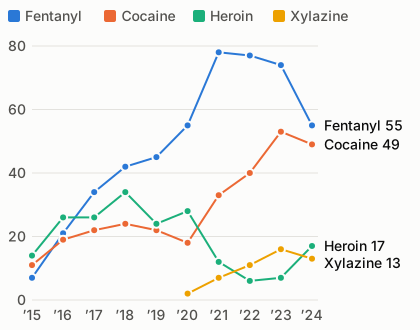
Fentanyl drives the numbers. It was found in 74 of the 89 Bridgeport resident deaths in 2023 and 55 of 74 in 2024. Cocaine is rising as a share: it appeared in 53 deaths in 2023 and 49 in 2024, up from 22 in 2019. Xylazine, a veterinary sedative, first appeared in Bridgeport resident deaths in 2020 (2 cases) and was in 16 in 2023. Statewide the picture improved in 2025: the Department of Public Health counted 836 overdose deaths, down about 45 percent from the 2021 peak, and the Greater Bridgeport planning region fell from 42.4 to 22.3 deaths per 100,000 between 2023 and 2025. That regional figure covers more than the city.
Drugs found in accidental overdose deaths of Bridgeport residents, 2015 to 2024. Our count of the Office of the Chief Medical Examiner open data (data.ct.gov), Oct 20, 2026. One death can involve several drugs; xylazine starts in 2020, the first year it appears in these records.
Local programs see new mixtures before the statistics do. In July 2025, Liberation Programs in Bridgeport told WSHU it was finding fentanyl mixed with medetomidine, and in August 2026 the same group warned News 12 about xylazine and fentanyl combinations. If you use, do not use alone, and carry naloxone. Our explainer on fentanyl and treatment covers what recovery looks like after fentanyl.
Naloxone in Bridgeport
Naloxone (Narcan) is sold without a prescription at most Connecticut pharmacies; the FDA approved the 4 mg nasal spray for over-the-counter sale on March 29, 2023. HUSKY and most private plans cover it, sometimes with a copay. Free kits and training in the Bridgeport area come from Catalyst CT's The Hub (203-579-2727) and from harm reduction programs such as Liberation Programs at 399 Mill Hill Avenue. DMHAS handed out 77,304 naloxone kits statewide in 2025.
Two Connecticut laws protect people who help. Anyone who gives naloxone in good faith to someone they believe is overdosing is immune from civil and criminal liability under § 17a-714a(d). And under the Good Samaritan law, the person who calls for help and the person overdosing are not prosecuted for possessing drugs found because of that call. Details are in Connecticut laws families should know.
After treatment
Sober houses, recovery coaches and meetings in Bridgeport
The free, walk-in place to start is CCAR's Bridgeport Recovery Community Center at 1057 Broad Street, (203) 332-3303. It is peer support, not treatment: recovery coaching, all-recovery meetings, family support groups, a recovery training series and telephone check-ins, all free of charge. Walk-in hours, per CCAR: Monday, Wednesday and Friday 8:30 a.m. to 4:30 p.m.; Tuesday and Thursday 8:30 a.m. to 6 p.m.; Saturday 10 a.m. to 2 p.m.; closed Sunday. The center has been open since August 2006.
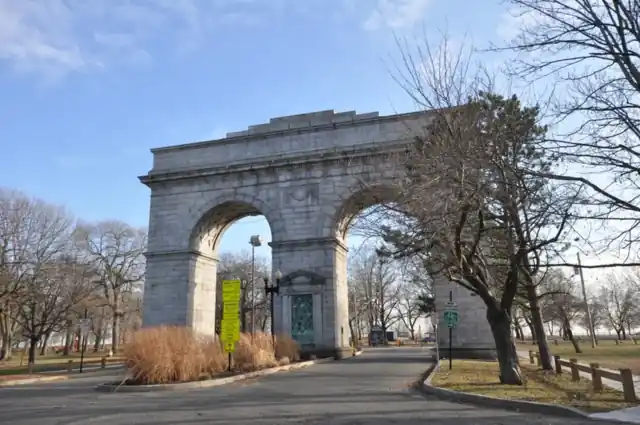
Perry Memorial Arch at Seaside Park, Bridgeport. Photo: Magicpiano, CC BY-SA 4.0, via Wikimedia Commons.
Sober houses and recovery houses in Bridgeport
Connecticut does not license sober houses, and DMHAS does not inspect or certify them. Certification comes from CTARR, the state affiliate of the National Alliance for Recovery Residences, or another body DMHAS recognizes. Under C.G.S. § 17a-716, a certified home may report itself to DMHAS, which publishes a weekly list with open beds; the law also bars a sober house from presenting itself as a treatment facility. To find a certified home, use CTARR's list of certified homes and the Sober Houses section of the DMHAS bed list at ctaddictionservices.com. In September 2026, CTARR's list showed three Bridgeport operators: Recovery Community Development, I Am Greater Living (women) and Park Place Sober House. Lists only include homes that chose to report, and open beds change daily.
Treatment agencies run several Bridgeport recovery houses. CASA Recovery House at 1124 Iranistan Avenue is transitional housing for men 18 and over, usually about 90 days with 24-hour support; CASA asks for a referral and Medicaid, with exceptions. Recovery Network of Programs runs a 37-bed Men's Recovery House on the third floor of 425 Grant Street, a 90-day program where residents attend IOP three days a week and people on medication treatment are accepted. RNP also runs Tina Klem Serenity House at 74 Huntington Road for women with both a substance use and a mental health condition. On October 20, 2026, the DMHAS bed list showed no open beds at CASA Recovery House or Tina Klem. We could not confirm a "Nexus" sober house in Bridgeport with any primary source, so it is not listed. Our sober living guide covers what to ask a house before you move in.
Sober house or halfway house?
What's the difference between a halfway house and a sober house? In Connecticut, it is treatment. A halfway house is licensed treatment: DPH licenses it as low-intensity residential care, longer-term and focused on returning to work. A sober house (sober living home) is housing without treatment. In between sit recovery houses, which are unlicensed transitional homes with support, usually for less than 90 days, and DMHAS-contracted supported recovery housing with case management. The national alliance NARR sorts recovery residences into four levels, from peer-run homes (Level I) and homes with a house manager, "frequently called sober homes or sober living" (Level II), up to staffed and clinical programs (Levels III and IV), per NARR. In Bridgeport, DMHAS lists CASA's halfway house under residential treatment.
AA and NA meetings
Connecticut AA's meeting list showed 39 AA meetings a week in Bridgeport on October 20, 2026, at 15 locations, 8 of them in Spanish and one online. Search by day and town at ct-aa.org, or call the Connecticut AA line at 866-783-7712; the list shows what is on today. For Narcotics Anonymous, the Connecticut Region helpline is 800-627-3543 and meetings are searchable at ctna.org. Are NA and AA meetings free? Yes: "There are no dues or fees for A.A. membership; we are self-supporting through our own contributions," says the AA Preamble, and NA has no initiation fees or dues; members give voluntarily at meetings. People on methadone or buprenorphine are welcome at NA meetings, though NA notes that members' views on medication vary. Open NA meetings welcome anyone; closed ones are for people with a drug problem. Be wary of commercial sites that look like official AA or NA directories.
Fairfield County, nearby
Programs within 10 miles of Bridgeport
Eleven more programs are within 10 miles of City Hall. Two are in Stratford, three in Fairfield, one in Southport, two in Shelton, one in Milford and two in Westport. They fill the gaps the city has. Eight of the 11 accept adolescents, two list detox, and four offer residential care, three of them Center for Discovery sites that describe themselves as eating-disorder programs. Payment is the catch: all 11 list private insurance, but only 7 take Medicaid, 2 offer a sliding fee, and four list private insurance as their only option. If you live in Stratford or Fairfield, the nearest program may be one of these rather than one in Bridgeport.
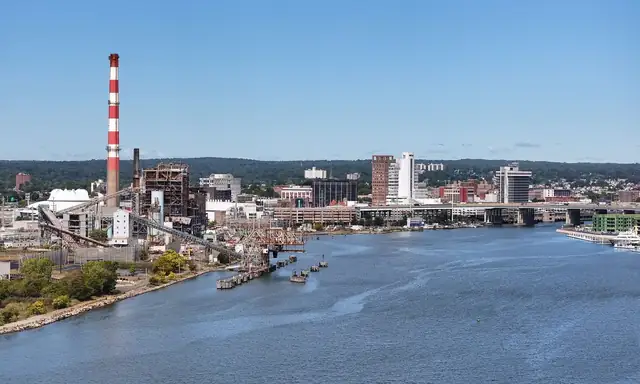
Bridgeport from across the water, 2025. The 11 ring programs are within 10 miles of City Hall. Photo: Quintin Soloviev, CC BY 4.0, via Wikimedia Commons.
The 11 programs, nearest first
Center for Human Services Stratford
The only methadone program in the 10-mile ring, in Stratford, 2 miles from City Hall.
Center for Discovery describes this site as a residential eating-disorder program for ages 10 to 17. SAMHSA also lists substance use treatment, so confirm it treats addiction before you go.
Center for Discovery describes this site as a residential eating-disorder program for adults 18 and over. SAMHSA also lists substance use treatment, so confirm it treats addiction before you go. Private insurance only.
Center for Discovery describes this site as a residential eating-disorder program for ages 18 to 26, although SAMHSA lists adolescents. Confirm it treats addiction before you go. Private insurance only.
Three Connecticut laws matter most to a Bridgeport family dealing with addiction: the Good Samaritan law, naloxone immunity and treatment without consent. These rules come up again and again. Each is a state statute you can read for free at the General Assembly's website; the section numbers below match the 2025 revision of the General Statutes, which the 2026 supplement did not change.
Calling 911 during an overdose
Under Connecticut's Good Samaritan law, C.G.S. § 21a-279(d) and § 21a-267(d), a person who calls for medical help for an overdose, and the person who overdosed, cannot be prosecuted for drug possession or paraphernalia found because of that call. The protection covers possession, not selling, and it does not apply if police were already there to serve an arrest or search warrant.
Naloxone without a prescription
Anyone may give naloxone to a person they believe is overdosing and is immune from civil and criminal liability for doing so (§ 17a-714a(d)). Since 2015, certified pharmacists can prescribe naloxone themselves and teach you how to use it (§ 20-633c), and since 2023 the nasal spray is also sold over the counter. State-regulated insurance plans cannot require prior authorization for naloxone (§ 38a-510b and § 38a-544b).
Treatment without consent, insurance rules and licenses
Emergency admission (§ 17a-684) and court-ordered treatment through the Probate Court (§ 17a-685) are described above. For insurance, Connecticut requires state-regulated plans to treat substance use no more strictly than physical illness (§ 38a-488c) and to cover medically necessary inpatient detox (§ 38a-492p). There is no general Connecticut ban on prior authorization for addiction treatment, so a plan may still ask for it, as long as it would for comparable medical care. Self-funded employer plans are governed by federal ERISA rules instead.
Connecticut requires addiction treatment facilities to hold a license from the Department of Public Health; the two state-run DMHAS sites in our list do not appear in that register. You can check any program for free on the state's eLicense lookup: choose the license type "Substance Abuse" and search by name or city. The state calls eLicense its primary source of verification. The state's open-data copy of that register on data.ct.gov, updated October 19, 2026, lists 18 active substance use licenses in Bridgeport and 4 in renewal; one organization can hold several.
Common questions
Rehab in Bridgeport: what people ask
How many rehab centers are in Bridgeport, Connecticut?
Fifteen programs that treat drug or alcohol use have a Bridgeport street address in SAMHSA's FindTreatment.gov locator, checked on October 20, 2026, and 11 more are within 10 miles. Thirteen of the 15 also match a Connecticut DPH license at the same address. Every one is listed with its services in the address-checked list on this page.
Is there a detox center in Bridgeport?
Two Bridgeport sites list detox. First Step at 425 Grant Street is a medically monitored residential detox unit for adults withdrawing from alcohol, opiates or benzodiazepines, run by Recovery Network of Programs. New Era Rehabilitation Center at 4675 Main Street also lists detox. The DMHAS Access Line, 1-800-563-4086, checks for open detox beds around the clock. See detox and inpatient care.
Where are the methadone clinics in Bridgeport?
Six Bridgeport sites are on SAMHSA's opioid treatment program list: CASA at 690 Arctic Street, North Star at 1106 North Avenue, First Step at 425 Grant Street, Liberation Programs at 399 Mill Hill Avenue, Kinsella Treatment Center at 1862 Commerce Drive and New Era at 4675 Main Street. Center for Human Services in Stratford is the nearest one outside the city. Details are in methadone and buprenorphine clinics.
What levels of care are available in Bridgeport?
Among the 15 address-checked programs, 12 offer standard outpatient care, 8 intensive outpatient (IOP), 2 a day program, 4 residential care, 2 detox and 1 hospital inpatient care, and 6 run methadone programs. Residential and detox are the scarce ones, so a bed may mean looking outside the city. Compare inpatient and outpatient rehab.
Which insurance plans are accepted at Bridgeport rehab centers?
Federal records list payment types, not insurance companies. Of the 15 Bridgeport programs, 13 accept Medicaid (HUSKY), 11 private insurance, 10 Medicare and 9 a sliding fee. Whether your specific plan is in network can only be confirmed by your insurer or the program. Call (866) 227-8929 and we will check your benefits with you, free of charge.
Do Bridgeport rehab programs take HUSKY (Medicaid)?
Most do: 13 of the 15 list Medicaid. HUSKY covers outpatient care, IOP, withdrawal management and, since June 2022, residential treatment for members age 13 and older at certified programs. HUSKY members can find in-network providers through the Connecticut Behavioral Health Partnership at 877-552-8247. To apply for HUSKY, call Access Health CT at 1-855-805-4325.
Can I get addiction treatment in Spanish in Bridgeport?
Yes. Ten of the 15 Bridgeport programs list services in Spanish, including CASA's Arctic Street site, Liberation Programs, Kinsella, New Era and the state-run Greater Bridgeport Community Mental Health Center. Connecticut AA lists 8 Spanish-language meetings a week in the city. Use the language filter in the list on this page to see them all.
Are there rehab programs for teens near Bridgeport?
Four Bridgeport programs accept adolescents: Child and Family Guidance Center, LifeBridge Community Services, Liberation Programs and Kinsella Treatment Center. Eight of the 11 programs within 10 miles also accept teens, in Stratford, Fairfield, Southport, Milford and Westport; two of them are Center for Discovery sites that describe themselves as eating-disorder programs, so ask whether they treat addiction. HUSKY covers residential treatment from age 13. Read more about teen rehab.
How much does rehab cost in Connecticut?
There is no reliable public average. The closest benchmark is what Connecticut proposed in 2022 to pay providers under Medicaid: about $153 to $342 a day for low-intensity residential care and $451 to $513 a day for medically monitored detox, plus room and board. Private programs set their own prices. Ask for a written estimate, or call (866) 227-8929 to compare options.
How long does rehab take?
Detox usually takes days: heroin withdrawal typically passes in 3 to 5 days, while methadone withdrawal can last 3 weeks or more, per SAMHSA's TIP 45. Treatment after detox takes longer. NIDA says most people need at least 3 months in treatment, and 12 months is the minimum for methadone maintenance. See how long rehab takes.
Where can I find a sober house in Bridgeport?
Connecticut does not license sober houses. Use the certified-home list from CTARR and the Sober Houses section of the DMHAS bed list at ctaddictionservices.com, which shows open beds. In September 2026, CTARR listed three Bridgeport operators. CASA and Recovery Network of Programs also run recovery houses for men in the city. Call (866) 227-8929 if you want help comparing options.
Are AA and NA meetings in Bridgeport free?
Yes. AA says there are no dues or fees for membership and groups are self-supporting through members' own voluntary contributions; NA has no initiation fees or dues either. Connecticut AA listed 39 meetings a week in Bridgeport in October 2026, 8 of them in Spanish. NA meetings are listed at ctna.org, and its helpline is 800-627-3543.
How do I verify my insurance coverage?
Call (866) 227-8929. Verification is free and confidential. You can also call the member number on your insurance card and ask which substance use programs in Bridgeport ZIP codes 06604 to 06610 are in network, or ask a program's intake team to check before your first visit.
Is help available 24/7?
Yes. Our helpline at (866) 227-8929 answers around the clock. The state DMHAS Access Line, 1-800-563-4086, is also open 24 hours a day for detox and residential referrals. For a mental health crisis, call or text 988, and in an emergency call 911. Connecticut's Good Samaritan law protects people who call for help during an overdose.
Rehab in Bridgeport: 7 facilities, one mid-size city economy, a specific version of Connecticut's broader treatment pattern. Most published coverage of city-level addiction data smooths out precisely the variation that matters — facility-by-facility clinical framework, insurance-network status, whether a specific program offers MAT. That variation is what this page is for.
The Connecticut context
The Connecticut story reaches Bridgeport through specific mechanisms. Expanded Medicaid in 2014 under the ACA. Overdose rate 34.7 per 100,000. concentrated fentanyl-related mortality in specific urban census tracts Each of those state-level facts has a local echo in what is available in Bridgeport and on what terms.
How access actually works in Bridgeport
The Bridgeport access question rewards patience and specific questions. The useful first step is rarely the closest facility — it is an evaluation by someone whose incentives are clinical, not financial. PCPs in Bridgeport prescribe MAT now; licensed substance-use counselors do initial assessments; federal helplines route without a commercial incentive. Any of those three beats cold-calling facility admissions.
Regional and nearby options
a mid-size local network typically covers general addiction-treatment needs well, with specialty capacity (dual-diagnosis, perinatal SUD, adolescent) often requiring a broader regional search. Regional thinking — Bridgeport plus the nearest metro — usually produces a better clinical match than strict in-city search. Especially for co-occurring conditions, perinatal SUD, or adolescent programming where mid-size city-level capacity is often thin.
Practical next steps
The next productive step in Bridgeport is boringly practical: call a primary-care doctor. PCPs now routinely prescribe buprenorphine, can initiate MAT, and have access to referral networks that the commercial side of the industry does not feed on. A PCP visit costs less and produces fewer surprises than a cold call to a Bridgeport facility admissions line.
Last updated October 21, 2026. Sources: SAMHSA Treatment Locator, CDC WONDER, KFF Medicaid Tracker, ASAM Criteria 4e. See our editorial policy.
Methodology
How we checked this list
54 rows exported from SAMHSA's FindTreatment.gov within 10 miles of downtown Bridgeport on October 20, 2026; distances on the cards are measured from City Hall, 45 Lyon Terrace
32 distinct sites after merging rows that share an address (one site can appear as a mental health, a substance use and an opioid treatment record)
15 sites inside Bridgeport and 11 within 10 miles that list substance use treatment or appear on the opioid treatment program list
25 features recorded per site, from detox to sign language and accreditation
13 of the 15 matched to an active or renewing Connecticut DPH license at the same address (state open data, October 19, 2026)
One record needed a manual check. First Step on Grant Street appears only on the opioid treatment program list, which carries no service detail, so we confirmed its detox unit on the operator's own page. Overdose figures are our count of the Office of the Chief Medical Examiner's open dataset for 2012 to 2024, by year of death and home address, with rates based on the 2020 Census; for 2023 and 2024 we matched the statewide totals to OCME, DPH and CDC releases.
What we did not check: opening hours, waiting lists, open beds and prices, which no public register publishes. Insurance companies are not listed because federal records only give payment types; we do not show "accepts Aetna" style claims for any program. We also did not call each program, so if something on a card is out of date, tell us through the contact page and we will recheck it against the register. This page was checked by the Birchwood Health editorial team under our editorial policy; it has not had a clinical review. Data checked October 20, 2026.